Rich Thinking vs Poor Thinking: How Your Mindset Shapes Money
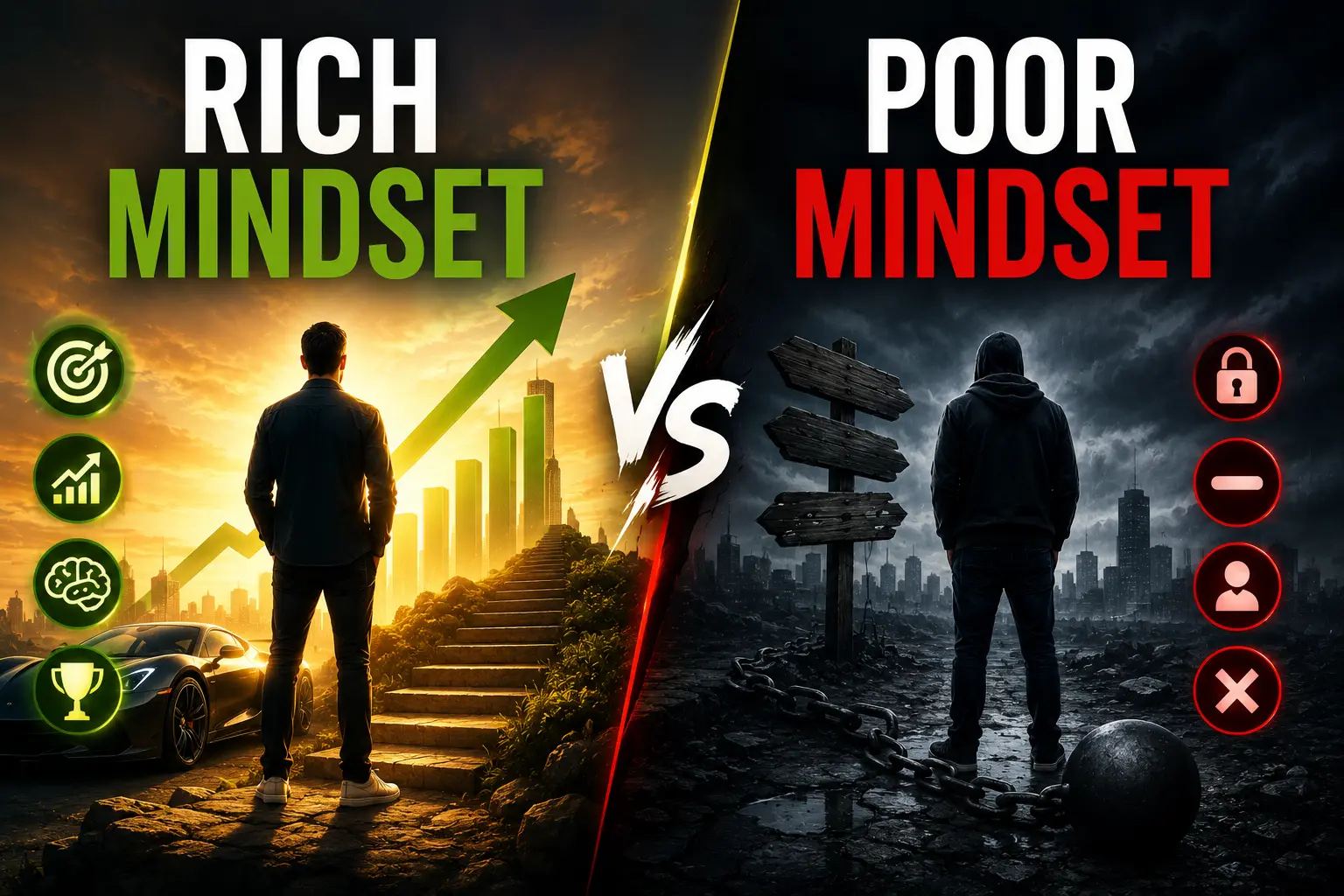
I have spent a lot of time thinking about money. Not just how to earn more of it, but how people think about it differently. Over time, I noticed something important: two people can have the same job, the same salary, and the same opportunities, yet end up in completely different places financially. The difference is almost never about luck. It is about mindset.
In this post, I want to share a simple idea that helped me change how I see money, work, and life. There are two main money mindsets: a poverty mindset and an abundance mindset. Understanding these two, and slowly shifting from one to the other, can change everything. If you enjoy reading, I have also shared a list of books that can change your thinking and lead you to prosperity, which connects directly to the ideas here.
What Is a Poverty Mindset?
A poverty mindset is a way of thinking about money that is built on fear and scarcity. This has nothing to do with how much money is in your bank account right now. I have seen people earning good salaries who still think in a very fearful way about money, and I have seen people with very little who think with abundance.
Common signs of a poverty mindset:
- Constant worry that there is never enough money, now or in the future
- Seeing the world as a limited pie: if someone else has more, there is less left for you
- Treating life as a strict trade: "I will help you only if you help me"
- Believing that for one person to win, someone else must lose
This mindset keeps people stuck. They waste energy focusing on what they lack instead of what they can create.
What Is an Abundance Mindset?
An abundance mindset is built on confidence and optimism. It does not mean you ignore problems or pretend everything is perfect. It means you choose to focus on possibility instead of fear.
People with an abundance mindset:
- See the world as full of opportunities, not a limited pie
- Believe other people's success does not block their own
- Look for win-win situations and are willing to give without expecting something back
- See money as something that can be created by offering value, ideas, and services to others
The key difference is simple. Scarcity asks, "What if there is never enough?" Abundance asks, "What can I build or learn next?"
How You See the World
One big difference between these mindsets is how you view the world itself.
With a poverty mindset:
- You see the world as unfair and stay stuck in anger about it
- You blame unfair systems or other people for your lack of success
- You wait for someone to rescue you or give you a chance
With an abundance mindset:
- You still see the unfairness, but you focus on what you can control
- You treat every failure as a lesson instead of a dead end
- You treat every success as something to be grateful for, not something you are owed
The world will never be perfectly fair. Your power is in how you respond to it. I explore this idea further in my guide on practical steps to become smarter and more successful, where I talk about building habits that move you forward regardless of circumstances.
How You Feel About Successful People
Another important area is how you feel when you see someone who is doing well.
Poverty mindset reactions:
- Jealousy and bitterness when others succeed
- Belief that most success is only from luck, inheritance, cheating, or connections
Abundance mindset reactions:
- Curiosity and respect toward successful people
- Desire to learn from them instead of tearing them down
- Seeing them as potential mentors or role models, not enemies
If you catch yourself hating someone just because they are successful, that is a signal to pause and ask yourself: "What can I learn from their story instead?"
How You Handle Competition
Competition is part of life: jobs, business, content, and even ideas.
With a poverty mindset:
- You feel discouraged when others do the same thing as you
- Thoughts like "Someone already did it, so there is no point" or "They will catch up, so why try?" are common
With an abundance mindset:
- You welcome competition as a challenge that pushes you to improve
- You may even become friends with competitors and look for ways to collaborate
- You understand that competition makes products, services, and people better
Instead of asking "Why bother?" you start asking "How can I offer something unique or more useful?"
Your Lifestyle and Work Habits
Mindset shows up clearly in how you live and work.
Poverty mindset lifestyle:
- Always focused on cutting costs, nickel and diming, and avoiding any spending
- Working long hours without rest, often with only one source of income
- Rare or stressful vacations, packed with activity to get the most for the lowest cost
- Sacrificing sleep, health, and time with family or friends to save a little money
Abundance mindset lifestyle:
- Focused on building a life that feels meaningful, not just busy
- Working toward doing things you are passionate about and creating multiple income streams over time
- Valuing sleep, health, and relaxation as essential, not as luxuries
- Hiring or asking for help for tasks where you are not uniquely skilled, instead of trying to do everything yourself
- Seeing travel, special dinners, and time with loved ones as important experiences, not a waste
Money is important, but time is finite. An abundance mindset treats money as a tool to improve life, not the only goal.
How You See Other People
Money mindset also affects relationships.
With a poverty mindset:
- You mainly see people as tools to reach an end: contacts, favors, or free help
- You stay interested in someone only if you think they can do something for you one day
- You believe most people have little to teach you, so spending time with them feels like a waste
With an abundance mindset:
- You build relationships based on trust, shared values, and genuine liking
- You stay connected without expecting something in return
- You believe you can learn something from anyone, regardless of age, status, or job
This shift makes life richer. People stop being resources and start being human again.
Hidden Signs of a Poverty Mindset
Some signs of a poverty mindset are subtle and easy to miss. Here are a few I have noticed:
- Feeling like a victim of other people's decisions
- Being scared to spend any money on non-essential items, even small treats
- Constantly hunting for cheaper alternatives, free stuff, deals, and coupons
- Feeling guilty when you succeed or have more than others
- Being afraid to share your achievements in case you sound like you are bragging
- Expecting others to always pick up the bill when you go out
- Saying things like "We can never afford that" or "Money does not grow on trees" over and over
Most of us learned these lines from parents, culture, and media. Noticing them is the first step to changing them.
Why Shifting Your Mindset Matters
Improving your relationship with money is not about pretending everything is easy. It is about changing the story you tell yourself so you can take better actions.
Moving from a poverty mindset to an abundance mindset:
- Makes daily life more enjoyable and less stressful
- Raises your chances of building wealth over time, not just in one lucky moment
- Helps you keep wealth when you do achieve it, because you no longer act only from fear
You do not have to change overnight. Start small:
- Notice when you speak from scarcity ("never", "cannot", "no way")
- Replace those lines with questions like "How could I make this possible?"
- Celebrate small wins instead of ignoring them
- Look at successful people as teachers, not threats
Step by step, your mindset shifts. And once your mindset shifts, your decisions and your results start to change too.
What kind of money mindset do you notice in yourself most often? Take a moment to reflect. The first step is awareness, and the rest builds from there.
Related Posts: