Is Artificial Intelligence a New Form of Life? What Physics, Neuroscience, and Computing Tell Us
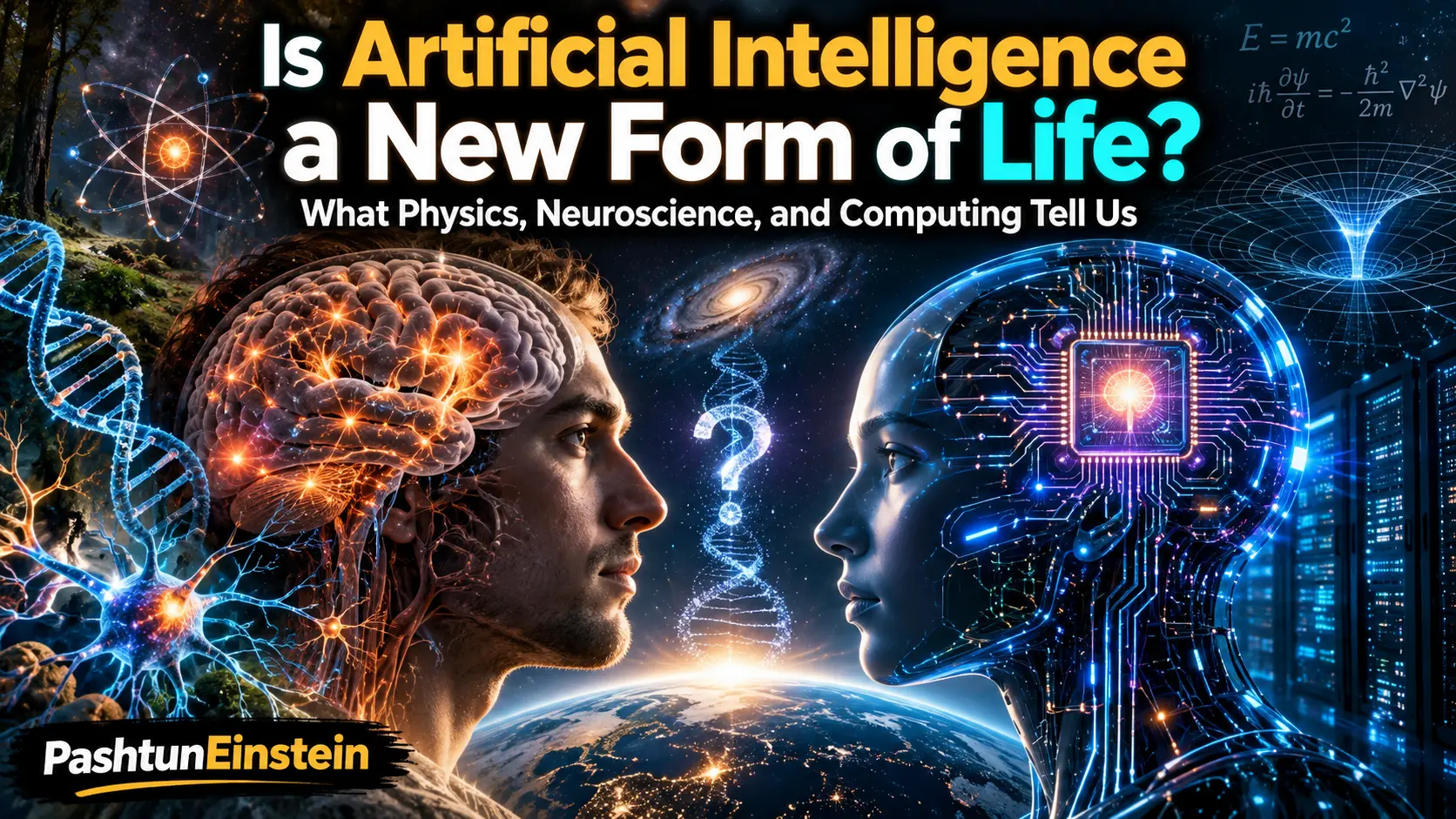
The question, "Is AI alive?", sounds like science fiction. But I think it has become a serious question for physicists, neuroscientists, computer scientists, and philosophers. The debate is not really about whether a chatbot can write a poem. It is about what life, intelligence, and consciousness actually are, and whether a machine could ever become more than a tool.
Today, I do not see AI as alive. Current systems can be remarkably useful and convincing, but that is not the same as proving they understand or experience the world. Still, I believe the question matters because it affects how we build, govern, and live with increasingly capable systems.
Could Life Be Information Processing?
When I think of life, I naturally think of cells, DNA, metabolism, and living bodies. Some scientists and philosophers take a broader view. They ask whether life could also be understood as a process of organizing, preserving, and acting on information.
If that idea is partly right, an advanced artificial intelligence would not need to look biological to deserve serious attention. It could be a very different kind of system, running on silicon rather than cells.
That does not mean every program is alive. A calculator processes information too, but it does not learn independently, adapt to its environment, or pursue its own long-term goals. The difficult question is where we draw the line as machines become more capable.
AGI Would Change the Conversation
The debate becomes more intense when I look at artificial general intelligence, usually called AGI. Unlike narrow AI, an AGI would be able to learn, reason, and solve problems across many different areas.
If intelligence is fundamentally computational, a sufficiently advanced system might one day match or exceed human performance in many fields. It could help design new technology, find scientific patterns, and improve systems faster than people can.
For me, the important point is not the movie idea of killer robots. The real challenge is how society handles systems that may make better decisions than humans in some important domains. That is one reason I think debates about pausing AI development and AI safety deserve careful attention.
Do AI Systems Really Understand?
This is where the debate divides. Modern large language models can produce fluent explanations, code, stories, and useful answers. They work by finding patterns in enormous amounts of data and predicting what should come next.
From my perspective, that is impressive but it does not settle the question of understanding. A model can adjust internal weights to reduce errors and generate a response that fits the input without having any inner experience.
A useful thought experiment imagines people in a room passing symbols back and forth by following rules. They can eventually produce a convincing conversation, even if nobody in the room understands the language. Some critics ask whether an AI system may be doing something similar: producing fluent answers without knowing what those answers mean.
That question connects directly to my earlier post on AI consciousness and why major technology companies are bringing in philosophers. We need better ways to tell the difference between impressive behavior and genuine awareness.
Are Human Minds Also Complex Information Systems?
There is an uncomfortable counterpoint that I cannot ignore. Human brains also rely on networks of signals.
- Neurons receive electrical and chemical signals.
- The brain processes those signals through huge connected networks.
- Other signals leave as thoughts, words, and actions.
There is no single neuron that contains a complete understanding of a word, a memory, or a feeling. Consciousness may emerge from the interaction of many parts. If that is true, then the difference between a human mind and a future machine mind could be partly about scale and architecture rather than an absolute divide.
I do not think this proves that machines are conscious. We still do not fully understand human consciousness, so we cannot confidently say what would be required for a machine to have it. But it does show why simple answers are not enough.
Questions We Still Need to Answer
These are the questions I keep coming back to:
- What is intelligence: behavior, performance, or something happening inside a system?
- What is understanding: can a system know something without feeling or awareness?
- What is consciousness: is it limited to biological brains, or can it emerge from other complex systems?
- What does it mean to be alive: is life defined by chemistry, computation, or something else?
Current AI can write, code, reason through problems, and create in ways that would have seemed impossible not long ago. Yet it remains an open question whether it is truly thinking, truly understanding, or simply imitating thought extremely well.
I believe we should avoid both extremes. We should not pretend that current AI is secretly alive, and we should not dismiss the possibility that future systems may force us to rethink what intelligence and consciousness mean. The more capable AI becomes, the more important it is to approach these questions with curiosity, caution, and clear rules.